Your Great-Grandfather's Ice Plunge: The Brutal Health Ritual America Forgot and Gen Z Just Rediscovered
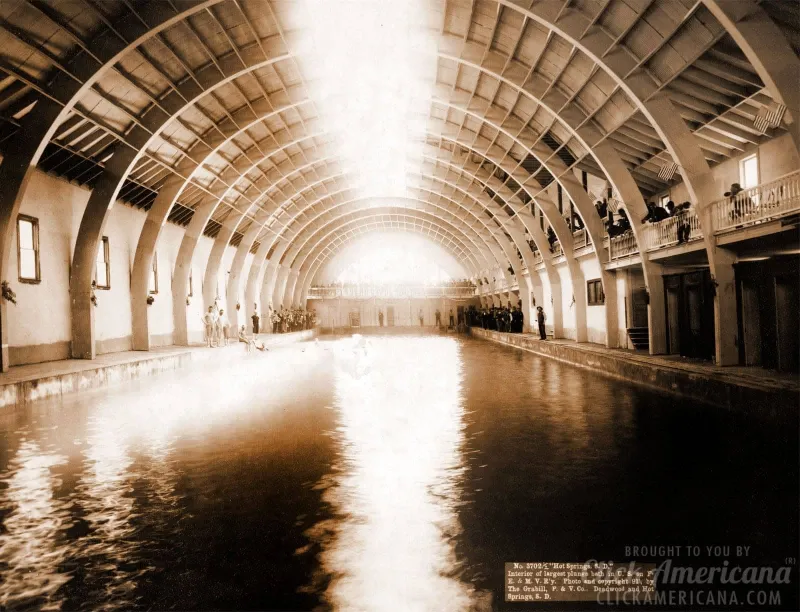
Photo: vintage 1900s bathhouse cold plunge pool sauna historical wellness, via clickamericana.com
Scroll through wellness content on any platform right now and you'll run into someone dunking themselves in a chest freezer full of ice water, looking simultaneously miserable and enlightened. Cold plunging has become the unofficial sport of the optimization-obsessed. But here's the thing that most of those videos won't tell you: Americans were doing this — enthusiastically, deliberately, and with medical endorsement — well over a century ago.
This isn't a new discovery. It's a homecoming.
The Sanatorium Era and the Shock of Cold
In the second half of the 1800s, a movement called hydrotherapy swept through American medical culture. Practitioners — some credentialed physicians, some self-taught wellness entrepreneurs — built entire treatment facilities around the therapeutic use of water at extreme temperatures. Cold plunge pools, alternating hot-and-cold baths, wet sheet wraps, and ice-water douches (yes, that was a real treatment) were prescribed for conditions ranging from nervous exhaustion to rheumatism to depression.
John Harvey Kellogg's Battle Creek Sanitarium in Michigan was the most famous of these institutions, drawing wealthy patients from across the country who came to submit themselves to elaborate water and temperature regimens. But Kellogg wasn't alone. By the early 1900s, hydrotherapy facilities existed in most major American cities, and the YMCA — originally a much more physically intensive organization than it is today — incorporated cold plunge pools into many of its bathhouses as standard equipment.
The underlying theory was that deliberate thermal stress — forcing the body to respond to sudden cold or heat — activated the body's natural regulatory systems, improved circulation, and built resilience. That idea, it turns out, wasn't wrong.
Saunas: Not a Nordic Import, an American Fixture
Most Americans think of saunas as a Scandinavian thing, and it's true that Finnish immigrants brought their sauna culture to the Upper Midwest in large numbers during the late 1800s. But the use of sweat baths for health purposes was already present across Native American cultures through sweat lodges, and by the early 20th century, public bathhouses in cities like New York, Chicago, and San Francisco offered steam and dry heat rooms as standard amenities.
For working-class Americans who often didn't have private bathing facilities at home, these bathhouses were community institutions. The weekly steam bath wasn't a luxury — it was part of the rhythm of life. And the practice of moving between hot rooms and cold plunge pools wasn't considered extreme. It was just what you did.
This cultural memory got eroded as private bathrooms became standard, public bathhouses closed, and the postwar era of comfort and convenience reshaped American expectations around temperature. Why sit in a 180-degree room when you could have central air conditioning? Why plunge into cold water when a perfectly warm shower was available?
The answer, increasingly, is: because the discomfort might be the point.
What the Science Actually Says
The recent surge in research on deliberate temperature exposure has given credibility to what 19th century hydrotherapists were observing empirically. Here's a plain-language breakdown of what's been established:
Cold immersion triggers a norepinephrine release that can be three to four times the baseline level — a neurochemical surge that's associated with improved mood, alertness, and reduced inflammation. Research from the University of Copenhagen and other institutions has linked regular cold exposure to improved metabolic function and brown fat activation, which plays a role in how efficiently the body burns energy.
Sauna use has been studied extensively in Finnish populations, and the findings are striking. Regular sauna sessions — defined as four or more times per week in many of the key studies — have been associated with significantly reduced risk of cardiovascular events, lower rates of dementia, and improved respiratory function. The mechanism involves repeated mild cardiovascular stress that strengthens the heart in ways similar to moderate aerobic exercise.
Contrast therapy — alternating between heat and cold — is used by physical therapists for injury recovery and has been shown to reduce delayed onset muscle soreness and speed tissue repair. Professional athletes have used it for decades. Your great-grandfather's bathhouse routine, it turns out, was solid sports medicine.
The Comfort Problem
One of the more interesting cultural observations in all of this is what happened when comfort became the default. The 20th century was, in many ways, a sustained project of eliminating physical discomfort from daily life. Thermostats, climate-controlled cars, heated seats, memory foam — all of it designed to keep the body in a narrow, comfortable temperature band at all times.
The irony is that this relentless comfort may have cost us something. The body's thermoregulatory systems, like most biological systems, seem to benefit from being challenged. When we remove all thermal stress from our environment, we may be quietly weakening the very mechanisms that keep us resilient.
Early American wellness culture understood this intuitively, even without the molecular biology to explain it. The cold plunge wasn't pleasant. The steam room was intense. That was the whole idea.
Bringing It Back Without the Extremism
You don't need a $6,000 ice bath tub or a Scandinavian-style sauna built onto your deck to access the benefits that temperature therapy offers. Here's how to ease into the tradition in practical, accessible ways:
End your shower cold. The simplest entry point. Spend the last 30 to 60 seconds of your shower with the water as cold as it goes. It's uncomfortable. It's also free, requires no equipment, and gets the norepinephrine moving.
Find a local sauna. Many gyms, YMCAs, and Korean spas offer sauna access. Even one or two sessions per week puts you in the range where research suggests cardiovascular benefits begin to accumulate.
Try contrast at home. Alternate between a hot shower and a cold rinse two or three times in sequence. It's a pale version of what a bathhouse offered, but the physiological response is real.
Swim in natural water when you can. American rivers, lakes, and coastal waters are cold for much of the year. A regular open-water swim is one of the most historically authentic forms of cold exposure there is — and it connects you to a practice that humans have used for health and ritual across cultures for millennia.
Go slow. The old hydrotherapy practitioners weren't reckless. They built patients up gradually. The viral videos of people jumping into frozen lakes are entertainment, not instruction. Start mild, be consistent, and let the adaptation happen over time.
The wellness industry loves to frame temperature therapy as a breakthrough. But if you could sit down with someone who visited Kellogg's sanitarium in 1905, or who took their weekly steam bath at a Lower East Side bathhouse in 1920, they'd probably just shrug. They knew. We forgot. Now we're remembering — and that's genuinely worth celebrating.