When Your Nose Was the Lab: Rediscovering America's Lost Language of Medicinal Plants
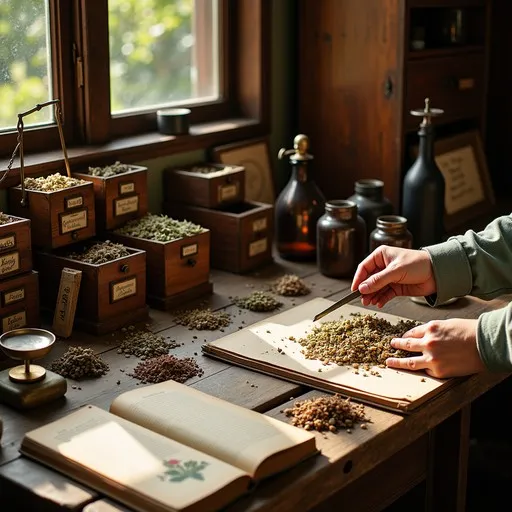
Photo: vintage apothecary dried medicinal herbs hands botanical, via images.stockcake.com
There's a particular kind of knowledge that lives in the hands. The way a grandmother could press her thumb into a piece of fruit and tell you exactly how many days it had left. The way an old farmer could crumble a clump of soil and read its moisture, its life, its mood. Pre-industrial Americans had that same wordless fluency with the plant world — and for a long time, that fluency was the difference between healing and suffering.
We've traded most of it away. Not because it stopped working, but because something shinier came along.
The Apothecary Didn't Need a Barcode
Walk into any pharmacy today and you'll find aisle after aisle of products with ingredient lists, dosage charts, FDA approval numbers, and warning labels running longer than some short stories. It's a system built on documentation, standardization, and institutional trust.
The early American apothecary operated on something older and arguably more personal: direct sensory knowledge passed down through generations.
Herbalists, root doctors, midwives, and kitchen healers across colonial and frontier America didn't consult a regulatory body when they needed to identify yarrow or distinguish black cohosh from a lookalike. They learned to read plants the way you learn to recognize a voice — through repeated, embodied experience. They rubbed leaves to release oils and memorized the smell. They tasted bark in small amounts and noted the bitterness, the astringency, the warmth. They felt the texture of stems, the weight of dried roots, the tackiness of certain resins.
This wasn't guesswork. It was a highly refined system of pattern recognition, one that took years to develop and was transmitted through apprenticeship, storytelling, and hands-on practice.
What Oral Tradition Actually Meant
We tend to use the phrase "oral tradition" in a way that accidentally makes it sound fragile or approximate. In reality, the botanical knowledge carried through oral tradition in early America was often extraordinarily precise.
Native American healers — whose plant knowledge heavily influenced both colonial settlers and the early American herbal tradition — had developed detailed, nuanced understandings of hundreds of medicinal species. This wasn't folk superstition dressed up in ceremony. Ethnobotanists who began documenting these traditions in the 19th and 20th centuries were repeatedly struck by how accurately the described uses aligned with the plants' actual chemical properties.
The same held true in the Appalachian herb traditions, in the Creole healing practices of Louisiana, in the German immigrant communities of Pennsylvania who brought their own botanical literacy from the old country and grafted it onto native American plants. These were living knowledge systems, constantly tested and refined by real outcomes.
Sensory identification was the foundation. You had to know the plant before you could use it safely or effectively. And knowing it meant knowing it with your whole body.
The Smell of Medicine
Aromatics were especially central to this approach. Plants in the mint family — spearmint, peppermint, lemon balm, catnip — were identifiable by their volatile oils long before anyone understood what a volatile oil was. Crush a leaf and the scent told you what you were dealing with. Herbalists understood that the same aromatic quality that made these plants smell good was also responsible for their digestive and calming properties, even without a chemistry degree to explain why.
Valerian root has a smell that's famously challenging — earthy, strong, and not exactly pleasant. But experienced herbalists knew that pungent funk meant they had the real thing, not a substitute. Goldenrod smells faintly sweet and anise-like when fresh. Wild ginger has a sharp, spicy warmth when the root is broken. Elderflowers carry a delicate, almost honeyed perfume that's completely distinct from the plant's berries.
These olfactory signatures were a built-in authentication system. Pharmaceutical standardization solved some real problems — contamination, mislabeling, inconsistent potency — but it also removed the average American from any direct relationship with the plants themselves. We stopped smelling our medicine.
Touch, Taste, and the Risk We Forgot How to Take
Taste was another primary identification tool, though one that required knowledge and care. Bitterness in certain roots signaled specific medicinal actions. The numbing, almost electric tingle of echinacea on the tongue was (and still is) considered a marker of quality by experienced herbalists. The sharp, warming bite of ginger. The mouth-coating astringency of blackberry root.
These sensory cues weren't arbitrary. They often corresponded directly to the active compounds responsible for the plant's therapeutic effects. Bitter compounds stimulate digestive secretions. Tannins, responsible for astringency, have antimicrobial and tissue-tightening properties. The compounds that create heat and tingling in plants like echinacea and spilanthes have measurable effects on immune function.
The old herbalists didn't have the vocabulary to describe it in those terms, but they understood the relationship between the sensory experience and the outcome. That's not primitive. That's empirical.
The Modern Renaissance Happening in Backyards and Herb Shops
Something interesting is unfolding right now in cities and small towns across the US. Enrollment in herbal study programs has climbed steadily over the past decade. Farmers markets with fresh medicinal herb vendors have waiting lists for vendor spots. Wildcraft walks — guided forays into local forests and meadows to identify and harvest medicinal plants — are selling out in places like Vermont, North Carolina, Oregon, and even urban parks in Chicago and New York.
The people showing up aren't just crunchy holdouts from the 1970s natural health movement. They're younger, more diverse, and often deeply frustrated with a healthcare system that feels expensive, impersonal, and chronically oriented toward symptom management rather than genuine wellness.
Many of them describe a specific hunger: they want to know things directly, not just be told what to take. They want to smell the difference between fresh and stale herbs. They want to grow something, harvest it, and understand how it works. They're reclaiming a kind of literacy their great-grandparents had as a matter of survival.
Herbalists like Rosemary Gladstar — who has been teaching plant medicine in Vermont for decades — have talked about this as a return to what she calls "the direct experience of plants." Not replacing modern medicine, but recovering a relationship that industrialization severed.
What We Lost, and What We Can Still Find
Let's be honest about both sides of this. Pharmaceutical standardization and FDA oversight exist for real reasons. Contaminated herbal products, mislabeled supplements, and dangerous drug-herb interactions are genuine concerns. The regulatory framework, however imperfect and often captured by industry interests, prevents some serious harm.
But something was lost in the bargain. We lost the expectation that ordinary people could and should understand their own medicine. We lost the neighborhood herbalist who knew your constitution as well as your name. We lost the practice of tasting, smelling, and touching the things we put in our bodies.
The good news is that loss isn't permanent. Plant knowledge isn't gone — it's dormant. It's sitting in out-of-print herbal manuals in used bookstores, in the memories of older Appalachian families, in Native American ethnobotanical records, in the hands of community herbalists who never stopped teaching.
You can still learn to identify yarrow by its feathery, fern-like leaves and faint medicinal scent. You can still crush a sprig of lemon balm and let that bright, lemony aroma tell you exactly what you're holding. You can still taste a sliver of fresh turmeric root and feel that earthy warmth bloom across your tongue.
Your nose is still a lab. Your hands still know how to learn.
Maybe it's time to let them.